Tiankai Off-Grid/Microgrid Integrated Photovoltaic-Storage-Charging Solution
I. Solution Overview With the rapid growth in energy demand from new energy vehicles, electric construction machinery, and remote areas, traditional power grids are struggling to meet the needs for flexible, efficient, and green energy supply.
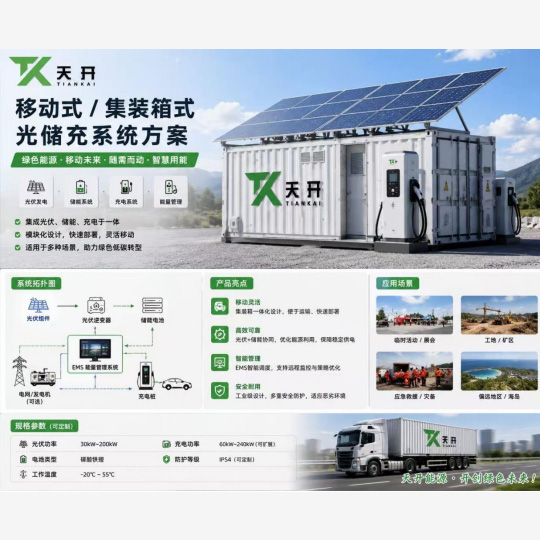
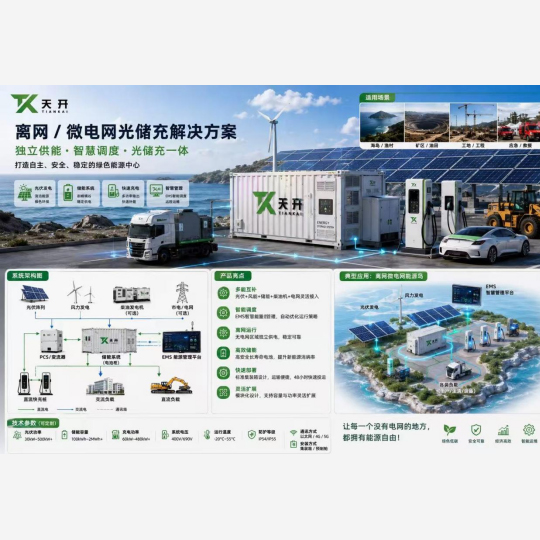
Tiankai’s off-grid/microgrid photovoltaic-storage-charging solution integrates photovoltaic power generation systems, energy storage systems, intelligent charging systems, and an EMS energy management platform to achieve integrated operation of power generation, storage, distribution, and charging, building an autonomous, safe, and stable green energy center.
The system supports three operation modes: off-grid, microgrid, and grid-connected, and is widely applicable in scenarios such as islands, mining areas, construction sites, oil fields, emergency rescue, and remote areas.
II. System Components
Photovoltaic Power Generation System: Utilizes solar energy resources for clean power generation, providing the main energy source for the system.
Features:
Reduces energy costs
Reduces carbon emissions
Improves renewable energy utilization
Supports expansion from 30kW to 500kW
Energy Storage System: Employs lithium iron phosphate energy storage batteries, with charge and discharge management achieved through a PCS bidirectional converter.
Main Functions: Peak shaving and valley filling
Energy storage
Power regulation
Emergency backup power
Configuration range:
100kWh~2MWh+
Intelligent charging system
Supports the charging needs of new energy vehicles and engineering equipment.
Supports:
DC fast charging
Heavy truck charging
Construction machinery charging
Energy storage charging
Charging power:
60kW~480kW+
EMS energy management system
As the core control platform of the system, it realizes:
Real-time data monitoring
Energy flow management
Battery status monitoring
Load management
Intelligent scheduling optimization
Remote operation and maintenance management
III. System Architecture
Photovoltaic modules
│
▼
PCS converter
│
▼
Energy storage system
│
▼
EMS energy management platform
┌───┼────┐
▼ ▼ ▼
Charging piles
AC loads
DC loads
Optional access:
Wind power generation
Diesel generators
Municipal power grid
Forming a multi-energy complementary microgrid system.
IV. Operating Modes
1. Off-Grid Mode
Suitable for:
Islands
Mining Areas
Mountainous Areas
Emergency Rescue
The system operates independently, without relying on the public power grid.
Advantages:
Self-sufficient power supply
Stable operation
Rapid deployment
2. Microgrid Mode
Suitable for:
Industrial Parks
Logistics Parks
Port Terminals
Achieves:
Prioritized photovoltaic power supply
Energy storage for peak shaving and valley filling
Intelligent load management
Reduced overall electricity costs.
3. Grid-Connected Mode
When the mains power is normal:
Prioritize photovoltaic power supply
Energy storage for peak shaving
When the mains power fails:
Automatic switch to off-grid operation
Ensuring continuous power supply to critical loads.
V. Product Advantages
Multi-Energy Complementarity
Photovoltaic + Energy Storage + Wind Power + Diesel Engine + Flexible Grid Connection
Intelligent Dispatch
EMS Automatic Optimization of Operation Strategy
Maximizing Energy Utilization
Off-Grid Operation
Independent Power Supply in Areas Without Grid Connection
More Reliable Power Supply
Rapid Deployment
Standard Container Design
Convenient Transportation
Quick Commissioning within 48 Hours
Flexible Expansion
Modular Design
Supports Capacity and Power Expansion
Safe and Reliable
IP54/IP55 Protection Rating
Adaptable to Complex Environments such as High Temperature, High Cold, and High Humidity
VI. Typical Application Scenarios
Island Microgrids
Solve island power supply problems
Achieve Green Energy Self-Sufficiency
Mining Area Energy Stations
Meet the charging needs of mining trucks and construction machinery
Reduce diesel consumption
Construction Sites
Integrate temporary power supply and equipment charging
Reduce generator usage
Oil and Gas Fields
Build independent energy systems
Ensure continuous production
Emergency Rescue
Rapid power supply at natural disaster and rescue sites
Ensure the operation of communication and medical equipment